Episode 02 · The Middleton Family · 1939
The future has a casting department.
How Westinghouse turned automation anxiety into a love story at the 1939 World's Fair.
Original Screen Salvage commentary · 6:56
The future needed a villain.
Watch the film's own dialogue become evidence: the labor fear it raises, the roles it assigns, and the two-dollar ring that settles an economic argument without answering it.
The Middleton Family at the New York World's Fair begins with a problem that still feels contemporary: young people are looking for their first jobs, machines are changing work, and nobody can say exactly what the future will require of them.
Westinghouse does not avoid that fear. Its sponsored film gives the objection a voice. Then it gives that voice to the least trustworthy man in the story.
A corporate film disguised as a family decision
The fifty-four-minute Technicolor feature follows an Indiana family through Westinghouse's exhibits: television, a Time Capsule, a dishwashing contest, and Elektro, the company's smoking robot. The company was selling pavilion attendance and electrical products, but it was also selling a way to interpret technological change.
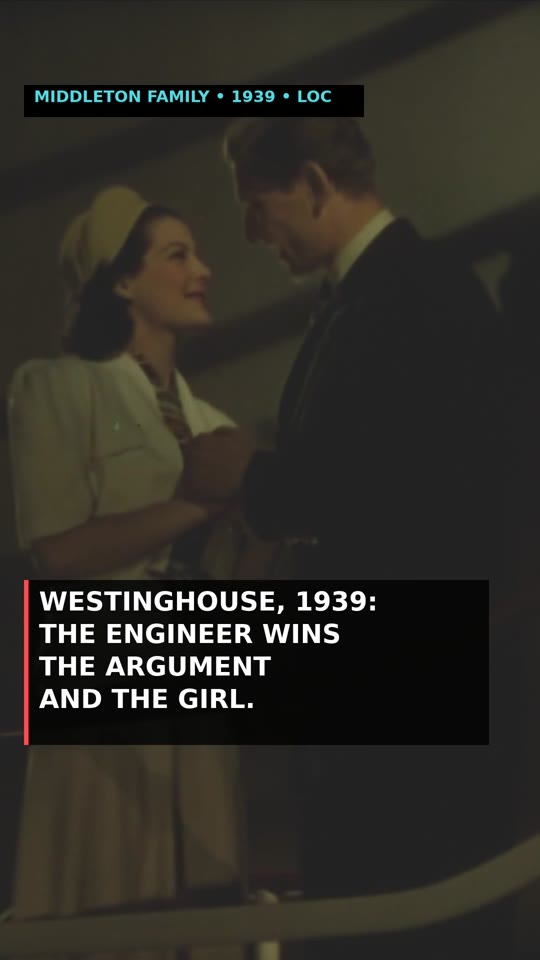
Its plot gives that interpretation a domestic shape. Bud Middleton worries about work. His older sister, Babs, must choose between two men. Jim Treadway is a hometown Westinghouse engineer. Nicholas Makaroff is her foreign-born, anti-capitalist art teacher. The economic argument and the romantic argument become the same story.
The anxiety is not a straw man
An opening radio report says more than six hundred thousand young Americans are looking for their first jobs. Later, Nicholas argues that power looms destroy jobs. His question is legitimate: mechanization can eliminate occupations, devalue skills, and impose severe transition costs even when new work appears elsewhere.
Westinghouse offers a cleaner chain. Jim says machines create better, cheaper products; lower prices increase consumption; consumption expands production; and expanded production creates labor demand. Wonder at what the machines can do becomes confidence in everything the sponsor says those machines will mean.
Credibility is assigned before it is earned
Jim is calm, informed, generous, practical, and useful. Nicholas is dour, pretentious, humorless, and fearful. Modern art, radical politics, foreignness, and romantic unworthiness are bundled together. The film lets him speak, but decides in advance how speaking will look.
This is more sophisticated than censorship. A sponsor can stage both sides of a debate and still determine its outcome by controlling warmth, competence, humor, romance, and the final word.
The two-dollar shortcut
Nicholas presents a ring as a family object with a history reaching back roughly three centuries. A shopkeeper later identifies the design as costume jewelry and offers a matching copy for two dollars.
The ring does not answer what happened to workers displaced by looms. It makes Nicholas personally unreliable. The film converts evidence about character into the feeling of evidence about economics.
When someone sells you the future, do not only ask what the technology can do. Ask who wrote the roles.
A better viewer test
- Who receives facts?
- Who receives warmth?
- Who is allowed to be funny, useful, calm, and desirable?
- Who is made irritating, fearful, fraudulent, or absurd?
- Which conclusion feels inevitable only after those roles have been assigned?
Sources and viewing
The receipts
- Library of Congress item and digital master ↗
- Andrew F. Wood's National Film Registry essay ↗
- Library of Congress public-domain Registry collection ↗
- Library of Congress feature on the Westinghouse Time Capsule ↗
Rights note: The Library of Congress includes this title in its public-domain National Film Registry collection. Screen Salvage uses the exact LOC master. This U.S.-focused basis does not automatically clear later restorations, added scores, trademarks, or uses in other jurisdictions.
Keep following the evidence
Get the next dossier.
Join the founding Screen Salvage list for source trails, new essays, and classroom-ready questions.